In modern space warfare, not every counterspace operation requires physically destroying a satellite. A soft kill anti-satellite weapon achieves mission denial by disrupting, degrading, or deceiving a satellite’s sensors, communications, or data links—without causing permanent physical damage. This distinction matters for military planners because soft kill options often leave fewer debris hazards and can be employed with greater strategic ambiguity.
Defining Soft Kill Anti-Satellite Weapons
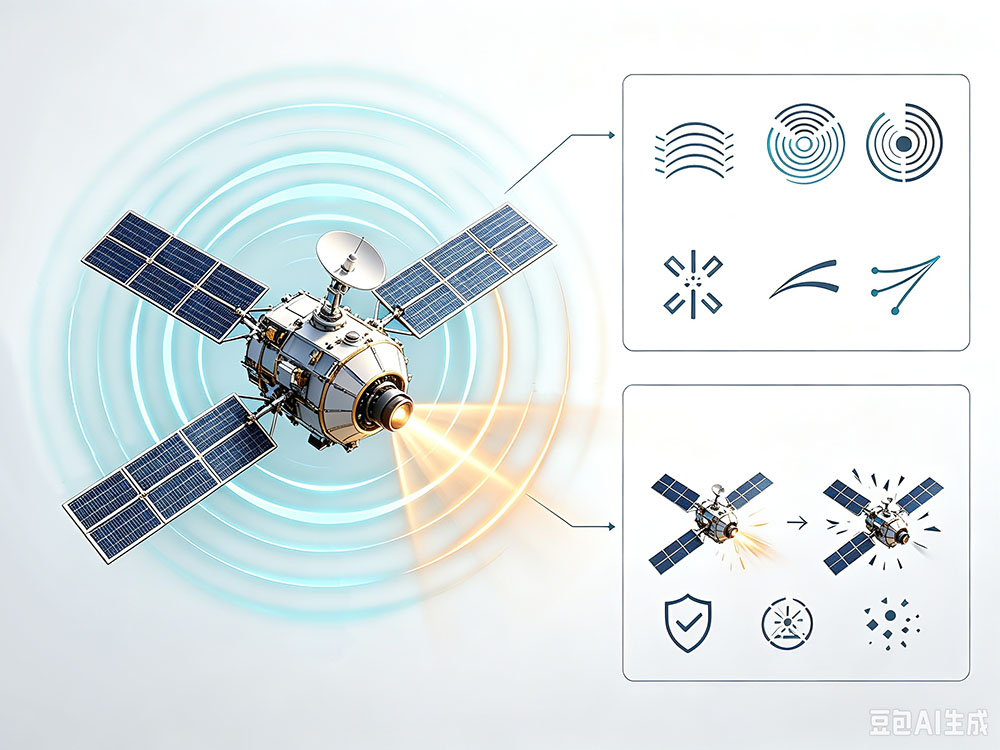
A soft kill anti-satellite weapon is any non-kinetic system or method designed to temporarily or reversibly impair a satellite’s function. Unlike hard kill weapons, which use projectiles, missiles, or directed energy to physically destroy or disable a spacecraft, soft kill techniques exploit vulnerabilities in the electromagnetic spectrum, onboard electronics, or ground-segment links. Common examples include laser dazzling, radiofrequency jamming, spoofing, and cyber attacks.
Primary Soft Kill Techniques Used Today
Several distinct methods fall under the soft kill umbrella. Each targets a different layer of the satellite architecture:
-
Laser dazzling or blinding: Low-power lasers overload optical sensors on imaging or missile-warning satellites without burning through structure.
-
RF jamming: Broadband or narrowband interference blocks uplink or downlink communication channels.
-
Spoofing: Injecting false commands or navigation signals to mislead the satellite or its users.
-
Cyber intrusion: Gaining unauthorized access to satellite control systems or ground stations to alter parameters or disable functions.
-
High-power microwave (HPM): Short bursts of electromagnetic energy disrupt onboard electronics without leaving visible physical damage.
Soft Kill vs. Hard Kill: Key Differences
| Feature | Soft Kill Anti-Satellite Weapon | Hard Kill Anti-Satellite Weapon |
|---|---|---|
| Physical destruction | No | Yes |
| Debris creation | None or minimal | Often significant |
| Attribution difficulty | High | Lower |
| Reversibility of effect | Usually reversible | Permanent |
| Cost per engagement | Low to moderate | High |
This comparison highlights why many military planners view soft kill options as more flexible and less escalatory than kinetic interceptors. However, the lower visibility of a soft kill anti-satellite weapon also creates challenges for verification and deterrence.
Advantages and Operational Limitations
Soft kill anti-satellite weapons offer several tactical benefits. They can be deployed covertly, leaving little physical evidence. Effects are often reversible, allowing a conflict to de-escalate without permanent loss of space assets. A soft kill anti-satellite weapon also typically costs far less per engagement than a direct-ascent missile or co-orbital kill vehicle.
Nevertheless, limitations exist. Effectiveness may depend on satellite hardening, redundant systems, or operator countermeasures. A single soft kill anti-satellite weapon might only degrade one sensor band or communication link, and its effect can fade quickly once the attack stops. Some satellites employ anti-jamming nulling antennas or radiation-hardened electronics that reduce vulnerability.
Legal and Strategic Implications
The use of soft kill anti-satellite weapons sits in a legal gray zone. The Outer Space Treaty prohibits harmful interference with peaceful space activities, but non-destructive interference is not always clearly defined. Military commanders must weigh operational gain against escalation risk and potential violation of international norms.
For further reading, the Secure World Foundation offers detailed assessments of counterspace capabilities, and the United Nations Office for Disarmament Affairs provides updates on space security discussions.
In conclusion, understanding what a soft kill anti-satellite weapon is requires looking beyond kinetic interceptors. As space becomes more congested and contested, non-destructive counterspace tools will play an increasingly central role in national security strategies. Procurement teams and policymakers must evaluate these systems not just on technical performance, but also on legal, strategic, and escalation-control grounds.