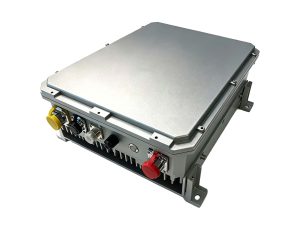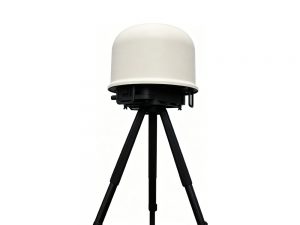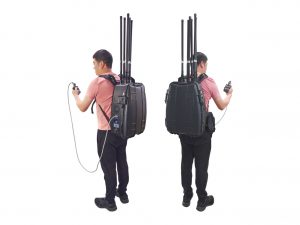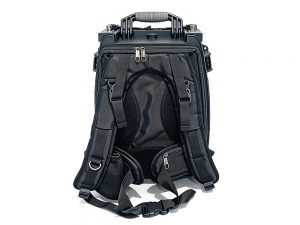
Our Starlink jamming platforms are built on a software-defined radio (SDR) architecture, enabling multiple sophisticated jamming modes that can be selected or programmed according to the operational scenario. The supported techniques include:
-
Broadband Barrage Jamming: The system transmits high-power noise across the entire Ku-band or Ka-band downlink/uplink spectrum simultaneously. This is the most assured method, as it does not require knowledge of the exact frequency channel in use. It guarantees denial but requires higher total RF power and may create a larger electronic footprint. Best suited for fixed-site perimeter denial or when complete spectrum dominance is required.
-
Swept Jamming: A narrowband high-power signal rapidly sweeps across the target frequency range. This concentrates available power into a small instantaneous bandwidth, achieving a higher jam-to-signal ratio on each channel sequentially. It is more power-efficient than barrage jamming and can be effective against slower frequency-hopping patterns.
-
Follower (Reactive) Jamming: The system uses a fast digital receiver to detect an active Starlink uplink or downlink transmission, then instantly generates a jamming signal on that exact frequency. Follower jamming is extremely power-efficient and subtle, as the jammer appears to be just another terminal transmitting on the same channel. It requires precise timing and very low-latency processing.
-
Protocol-Aware / Smart Jamming: By analyzing the structure of the Starlink physical layer and media access control (MAC) frames, our jammers can specifically target synchronization preambles, control channels, or scheduling request slots. This disrupts communication with minimal transmitted energy and can be designed to evade certain signal classification algorithms, as the waveform can mimic legitimate but disruptive signaling structures.
-
Pulse Jamming: Short, high-energy pulses are transmitted at precise intervals to corrupt specific timed bursts within the TDMA (Time Division Multiple Access) frame structure. This is highly power-efficient and can be synchronized with external timing references to maximize disruption while creating minimal interference.
-
Tone Jamming: Single or multiple continuous-wave (CW) tones are injected into the receiver bandwidth. This can be used to exploit specific vulnerabilities in the receiver’s automatic gain control or phase-locked loop, potentially causing desensitization or loss of lock with less power than noise jamming.
-
Modulated Jamming: The interference signal is modulated with random or pseudo-random data, such as fake OFDM symbols or scrambled bitstreams. This makes it more difficult for the victim terminal to distinguish the jamming from a legitimate co-channel interferer, potentially delaying the triggering of anti-jamming countermeasures.
Operators can switch between modes in real time via the graphical user interface. Custom jamming waveforms can also be developed and loaded based on specific operational intelligence or emerging counter-countermeasure requirements.