
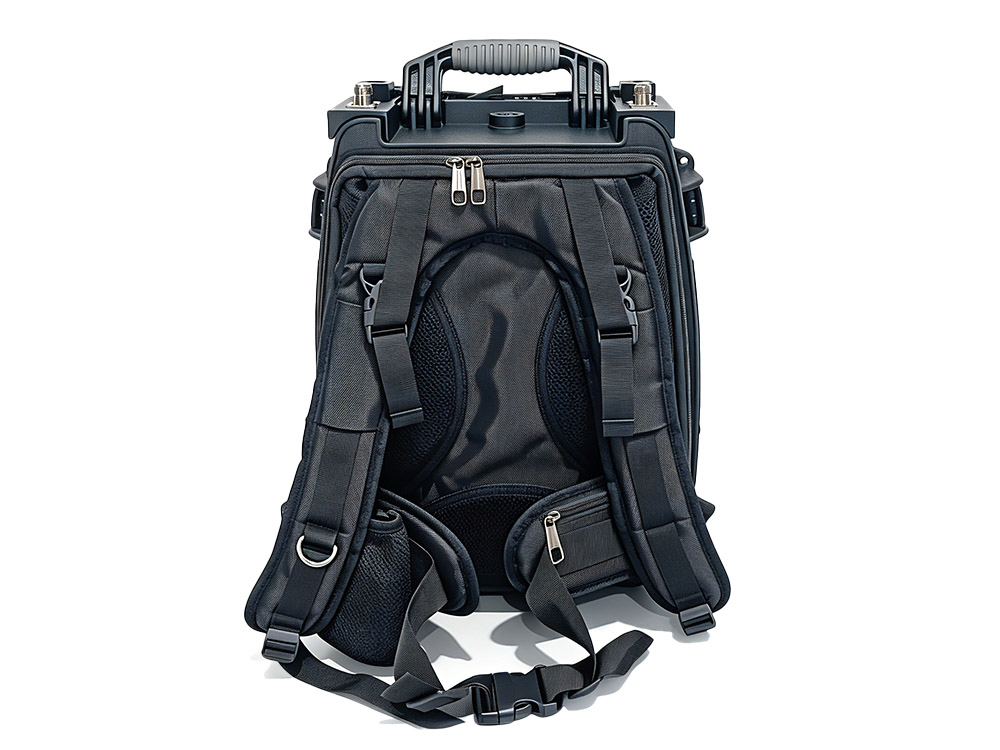
Portable Backpack Starlink Jammer BNT-S900-B1 covers 10.7–12.7GHz, 47dBm output, 8 freq points, 90-min battery. Tactical Ku-band interference for field operations.
The BNT-S900-B1 Backpack Starlink Jammer is a man‑portable, battery‑powered countermeasure system purpose‑built to disrupt Ku‑band satellite downlinks in the 10.7–12.7GHz range. Designed for rapid deployment in contested electromagnetic environments, this backpack‑configured jammer gives field operators a decisive tool against Starlink terminal communications – without the logistical burden of vehicle‑mounted or fixed installations.
Weighing approximately 16 kg (antenna excluded) and running on an internal 24V 7S 30Ah battery pack, the BNT‑S900‑B1 supports sustained field missions of ≥90 minutes of continuous operation. Its ruggedized construction, efficient forced‑air cooling, and instant‑on capability make it a natural choice for special reconnaissance, forward operating bases, and critical infrastructure protection where mobility and speed of action are paramount.
Compared to stationary jammers, the backpack form factor enables operators to reposition quickly, adapt to shifting intelligence, and engage targets from unexpected azimuths – a tactical advantage that fixed emplacements cannot offer.
At its core, the BNT‑S900‑B1 operates on a straightforward yet highly effective principle:
Signal generation – An integrated SDR (Software‑Defined Radio) engine produces jamming waveforms across the entire 10.7–12.7GHz band, with an instantaneous bandwidth of ≥500MHz.
Amplification – The generated signal passes through a solid‑state power amplifier (PA) delivering an adjustable output from 20dBm up to 47dBm (≈50W), with 1dB step resolution.
Directional radiation – The amplified signal feeds a dedicated 20dBi directional antenna, which focuses the RF energy into a narrow beam toward the target Starlink terminal.
Effect – At the target location, the jamming power overcomes the satellite’s typical downlink signal level (–60 to –80dBm), effectively denying the terminal’s ability to lock onto the satellite.
The system can operate in continuous wave (CW) or intermittent burst modes, with programmable transmission durations. This flexibility allows operators to balance jamming effectiveness against power consumption and thermal constraints.
| Feature | Benefit |
|---|---|
| Backpack form factor | Enables one‑person carry, rapid deployment, and discreet movement in urban or rugged terrain. |
| Wide instantaneous bandwidth (≥500MHz) | Covers multiple Starlink frequency sub‑bands simultaneously, defeating frequency‑hopping attempts. |
| ≥8 simultaneous jamming points | Engage multiple terminal channels at once, increasing overall mission effectiveness. |
| 47dBm peak output power | Provides sufficient margin against satellite downlink signals, even in adverse weather or at extended ranges. |
| 1dB power adjustment steps | Allows fine‑tuning of jamming intensity to minimise collateral interference and conserve battery. |
| Multiple modulation schemes (BPSK/QPSK/16QAM/64QAM/128QAM) | Adapts to different signal structures, making the jammer effective against varied Starlink terminal firmware versions. |
| Internal forced‑air cooling system | Maintains stable performance even during extended jamming missions, prolonging system life. |
| External DC24V backup power | Extends mission duration when a vehicle or stationary power source is available. |
| Parameter | Specification |
|---|---|
| Operating Frequency | 10.7GHz – 12.7GHz (Ku‑band) |
| Instantaneous Bandwidth | ≥500MHz |
| Simultaneous Jamming Frequencies | ≥8 points |
| Output Power Range | 20dBm – 47dBm (step 1dB) |
| Transmission Mode | CW or burst (programmable duration) |
| Jamming Waveforms | Single‑tone, swept, wideband noise, PRBS pseudo‑random |
| Modulation Formats | BPSK, QPSK, 16QAM, 64QAM, 128QAM (software‑expandable) |
| Primary Power | Internal 24V 7S 30Ah battery |
| Backup Power | External DC24V input |
| Operating Temperature | –25°C to +55°C |
| Antenna Gain | 20dBi directional |
| Weight (excl. antenna) | ≈16 kg |
| Battery Runtime | ≥90 minutes (continuous) |
| Control Interface | RJ45 Ethernet |
Concentrates full output power on one specific frequency – ideal when the target terminal’s operating channel has been precisely identified via direction‑finding (DF) assets.
Rapidly sweeps across the band to disrupt multiple channels in a time‑sharing manner. Useful when the target’s frequency agility pattern is unknown or when engaging multiple terminals with different channel assignments.
A broadband barrage that covers the entire downlink segment, ensuring that any Starlink terminal within the antenna’s beamwidth receives a high noise floor – effective for area denial.
Mimics the statistical properties of legitimate satellite signals, making the interference harder to distinguish from natural or accidental noise, which complicates the adversary’s electronic warfare (EW) counter‑measures.
By configuring the jammer to emit signals using the same modulation (e.g., QPSK or 16QAM) as Starlink downlinks, the BNT‑S900‑B1 can generate co‑channel interference that is particularly effective at degrading demodulation performance, even at lower power ratios.
In forward battle zones, the BNT‑S900‑B1 can be carried by a two‑man EW team to blind enemy Starlink terminals, cutting their real‑time video feeds, command‑and‑control links, and intelligence uploads. Its directional antenna ensures that friendly forces operating outside the main beam experience minimal impact.
Power plants, communication hubs, and border checkpoints can deploy this backpack jammer as a rapid‑response unit when suspicious satellite signals are detected. The RJ45 interface allows integration with external spectrum monitoring systems, enabling automated reaction.
During large‑scale public events or sensitive government meetings, the jammer provides a portable, quickly‑erectable spectrum containment solution – preventing unauthorized live‑streaming or data exfiltration via commercial satellite networks.
The internal battery pack is engineered for deep‑discharge resilience, delivering ≥90 minutes of full‑power operation under normal ambient conditions (25°C). A dedicated smart charger replenishes the battery in approximately 4 hours.
The cooling subsystem combines a high‑efficiency centrifugal fan with an extruded aluminium heatsink that directly contacts the power amplifier’s heat‑spreading plate. This design maintains the PA junction temperature well below the derating threshold, even when operating at 47dBm in 55°C environments. The fan speed is dynamically regulated by an onboard temperature sensor, balancing noise signature against cooling demand – a critical factor in covert operations.
The supplied 20dBi directional antenna exhibits a narrow beamwidth (typically 12°–15°), which concentrates the effective radiated power (ERP) to approximately 67dBm (47dBm + 20dB) at peak output. Given the typical Starlink downlink level of –60dBm at the terminal’s low‑noise block (LNB), the jammer maintains a comfortable power advantage even at 5‑kilometre ranges, assuming free‑space path loss of ~120dB.
| Range | Free‑Space Loss (approx.) | Received Jammer Power (EIRP 67dBm) |
|---|---|---|
| 1 km | 106 dB | –39 dBm |
| 3 km | 116 dB | –49 dBm |
| 5 km | 120 dB | –53 dBm |
Note: Actual performance depends on terrain, atmospheric absorption, and antenna alignment accuracy.
BNT‑S900‑B1 jammer host unit ×1
Directional antenna assembly ×1
Power cable ×1
Battery charging adapter ×1
Quick‑start guide & safety documentation ×1
(The custom‑moulded backpack carrier is supplied separately upon request.)
For a deeper understanding of Ku‑band propagation and satellite communications resilience, readers may refer to the ITU‑R P.525 recommendation on free‑space attenuation, as well as open‑source analyses published by the C4ADS organisation regarding Starlink’s spectrum usage patterns. For technical comparison with stationary jamming platforms, explore our vehicle‑mounted jamming solutions and fixed‑site EW systems.
Truly portable: One operator, one backpack – no vehicle, no trailer.
Mission‑ready instantly: Power‑on to jamming in under 60 seconds.
Field‑proven reliability: Operating temperature range from –25°C to +55°C ensures performance in deserts and arctic conditions alike.
Upgradeable architecture: SDR‑based design allows new modulation schemes and jamming algorithms to be uploaded via the RJ45 Ethernet port.
Cost‑effective: Compared to airborne or ship‑borne EW systems, this backpack starlink jammer offers a fraction of the lifecycle cost while delivering decisive tactical effect.
For technical consultation, customisation requests (e.g., alternative frequency bands or export‑controlled variants), or to request a demonstration unit, please contact our electronic warfare solutions team directly.
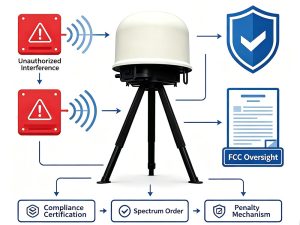
WASHINGTON — As Starlink expands its satellite internet footprint, search interest in “Starlink jammers” has grown alongside it. But under U.S....

The satellite connectivity market is expanding fast. So is regulatory scrutiny of devices designed to interfere with it. As Starlink...
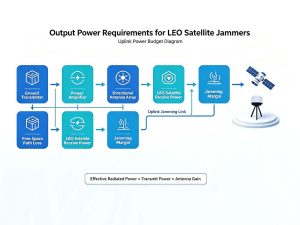
The phrase “Starlink jammer output power requirements for LEO satellites” suggests a straightforward engineering number: a certain wattage needed to...
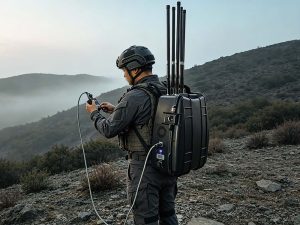
A Backpack Becomes a Spectrum Tool Special forces have a new wish list item. It is not a rifle or...