The difference between uplink and downlink Starlink jamming is often reduced to a simple question: which direction is easier to disrupt? The real answer involves power budgets, orbital geometry, and receiver sensitivity. In this guide, we examine five critical technical distinctions that shape interference analysis.
Downlink vs Uplink: Core Concepts
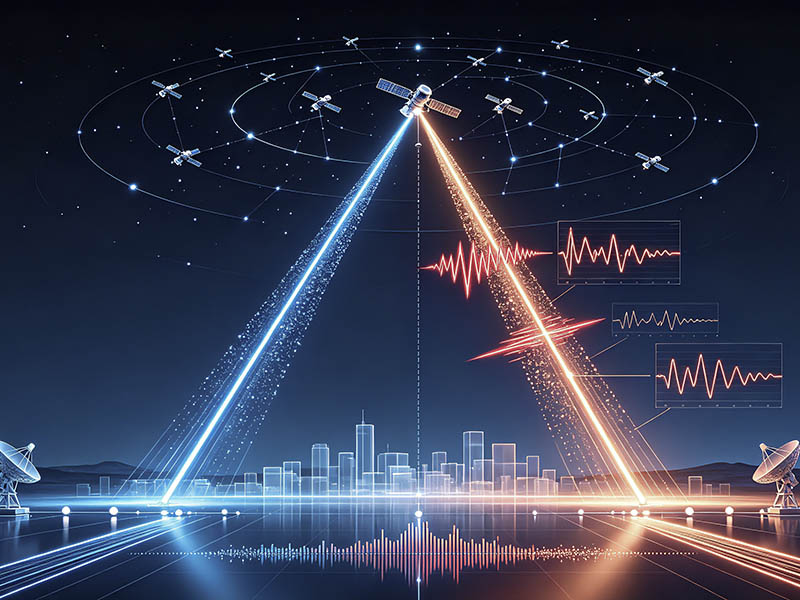
Starlink user terminals maintain two active links. Downlink signals travel from satellites to terminals. Uplink signals travel from terminals to satellites. The difference between uplink and downlink Starlink jamming begins with which receiver is being targeted.
A downlink jammer aims at a user terminal on the ground. An uplink jammer aims at a satellite passing overhead. That single distinction changes the required power, antenna gain, and tracking accuracy. Engineers use this contrast to prioritize spectrum monitoring and threat modeling.
Why Downlink Jamming Is More Common
Downlink jamming is more accessible because the target receiver is local. A terminal on a vehicle or fixed site receives Ku-band downlinks between 10.7–12.7 GHz and Ka-band downlinks between 17.8–19.3 GHz. The satellite beam covers a large footprint, so a jammer can inject noise across a wide area with moderate power.
In practical terms, a downlink jammer does not need to track a moving satellite precisely. It just needs to be near the terminal or within the beam coverage. This is a core part of the difference between uplink and downlink Starlink jamming. As a result, downlink jamming is the first concern for military planners and network security teams.
Why Uplink Jamming Is Technically Harder
Uplink jamming targets the satellite receiver. The jammer must overcome the terminal’s highly directional phased-array uplink, operating around 14.0–14.5 GHz or 27.5–30.0 GHz. Because Starlink satellites use narrow receive beams and move rapidly, the jammer must track the satellite and maintain exact alignment.
This requires high effective isotropic radiated power, precise pointing, and often real-time orbital data. The difference between uplink and downlink Starlink jamming is therefore not just direction; it is a gap in complexity. A successful uplink jammer can affect many terminals served by that satellite, but the engineering barrier is significantly higher.
Five Critical Differences at a Glance
The table below condenses the main technical contrasts.
| Factor | Downlink Jamming | Uplink Jamming |
|---|---|---|
| Target receiver | User terminal | Satellite |
| Distance | Local, ground level | 550 km to orbit |
| Key frequencies | 10.7–12.7 GHz, 17.8–19.3 GHz | 14.0–14.5 GHz, 27.5–30.0 GHz |
| Power requirement | Moderate | High |
| Beam tracking | Wide, simpler | Narrow, complex |
| Typical detection | Easier, local spectrum sensors | Harder, satellite-side monitoring |
Downlink interference is easier to detect because the affected terminal can log signal-to-noise drops. Uplink interference may only appear as a network-wide capacity reduction, making attribution more difficult.
Detection and Legal Considerations
Understanding the difference between uplink and downlink Starlink jamming supports better detection strategies. Downlink jamming can be identified with ground-based spectrum analyzers near user terminals. Uplink jamming may require satellite telemetry or coordinated monitoring across multiple ground stations.
Intentional jamming is illegal under FCC rules and ITU radio regulations. Authoritative sources such as the FCC licensing database and the ITU spectrum portal define lawful emissions.
Key Takeaways
The difference between uplink and downlink Starlink jamming is a spectrum of trade-offs. Downlink attacks are easier but local. Uplink attacks are harder but broader in potential impact. For network defenders, downlink monitoring should come first. Uplink monitoring should focus on terminal clusters and licensed bands.
Use calibrated equipment and official licensing data. Never attempt jamming outside authorized test environments.