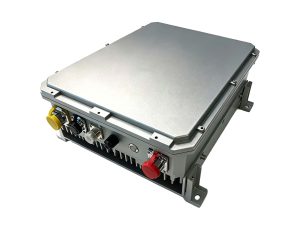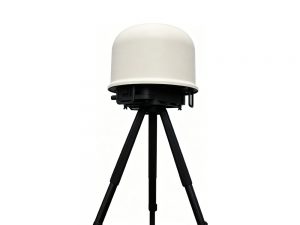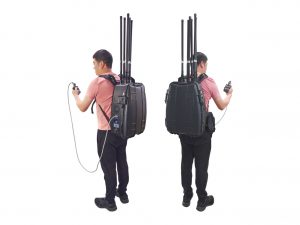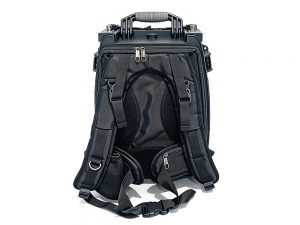
Backpack vs fixed-site Starlink jammer deployment scenarios start with one question: does the operator need to move during the denial window? A backpack unit trades output power and antenna size for mobility. A fixed-site rig maximizes effective isotropic radiated power (EIRP) and duty cycle. Neither is universally better; each fits a specific mission envelope.
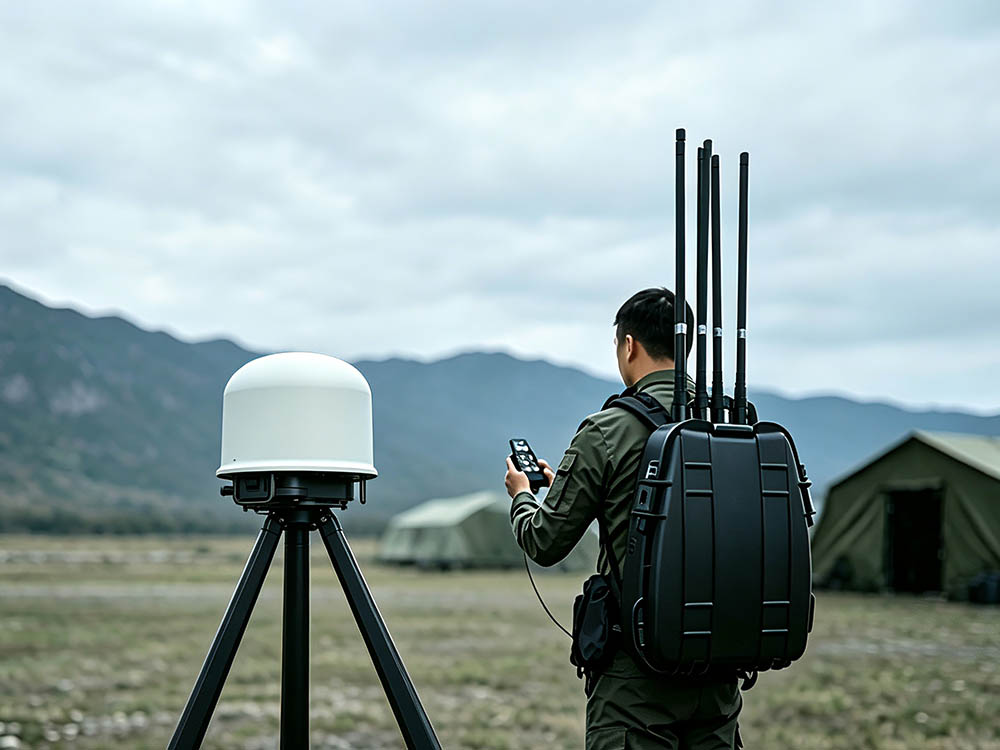
Core Variables in Backpack vs Fixed-Site Starlink Jammer Deployment Scenarios
Before selecting hardware, teams evaluate four technical constraints:
-
Power budget: A backpack system typically carries 50–150 Wh of battery. A fixed site can draw from mains or a generator, allowing 500 W continuous RF output for hours.
-
Antenna gain: Fixed sites can mount a high-gain parabolic or phased-array antenna on a mast. Backpack units use compact, lower-gain antennas, limiting range to a few hundred meters.
-
Cooling: Fixed-site amplifiers have forced-air or liquid cooling. Backpack units rely on passive heat sinks, which cap transmission time.
-
Legal perimeter: In authorized tests, a fixed site inside a shielded enclosure is easier to certify than a moving backpack. Regulators such as the FCC Office of Engineering and Technology and the ITU Radiocommunication Sector require clear emission boundaries.
Five Field Scenarios Compared
When evaluating backpack vs fixed-site Starlink jammer deployment scenarios, team leads often ignore antenna height. Yet mast elevation changes everything at Ku-band frequencies. The table below summarizes practical suitability.
| Scenario | Backpack Suitability | Fixed-Site Suitability |
|---|---|---|
| Urban tactical exercise | High – rapid repositioning between buildings | Low – mounting and power access limited |
| Rural range denial test | Low – coverage area too small | High – mast height and EIRP extend reach |
| Mobile convoy protection | High – moves with vehicle or operator | Not applicable |
| Temporary checkpoint | Medium – setup in under 2 minutes | High – if vehicle or trailer provides power |
| Laboratory shield-room validation | Low – limited need for mobility | High – precision and logging requirements |
For a convoy protection detail, a backpack unit allows an operator to dismount and reposition as the convoy route changes. The trade-off is a narrower jamming radius. A fixed-site installation at a forward operating base, by contrast, can run 24/7 with remote monitoring and automated frequency hopping.
The term backpack vs fixed-site Starlink jammer deployment scenarios also appears in RF red-team planning. Red teams often start with a backpack jammer to probe the physical perimeter, then graduate to a fixed-site amplifier once the target’s receive sensitivity is mapped. This two-phase approach reduces wasted transmit power.
Practical Selection Checklist
Use this checklist when the deployment scenario is still ambiguous:
-
Movement during operation: If the team moves more than once per hour, choose backpack.
-
Required continuous jamming time: Under 30 minutes favors backpack; over 4 hours favors fixed-site.
-
Target distance: Beyond 1 km, fixed-site is almost mandatory unless using directional backpack antennas.
-
Power source access: No grid or generator? Backpack is the only option.
-
Legal documentation: Fixed sites are easier to describe in a license application because the geographic boundary is static.
In summary, the decision between backpack vs fixed-site Starlink jammer deployment scenarios hinges on mobility, power, and duration—not on raw output power alone. Most serious RF denial programs eventually maintain both form factors. The backpack handles dynamic, short-duration tasks. The fixed-site rig handles sustained, high-duty-cycle denial. Mapping those roles before procurement avoids expensive equipment sitting idle or, worse, operating outside its certified envelope.