Project Background and Pain Points
The electromagnetic security team at a high-value government compound had a problem that off-the-shelf spectrum analyzers couldn’t solve. Unauthorized Starlink terminals were being detected intermittently just outside the fence line—likely streaming video or passing sensor data back to an unknown third party. The 14 GHz uplink beam from a Starlink dish is narrow as a laser pointer, and conventional monitoring gear rarely catches it. When it does light up, there’s no second chance. Worse, without a dedicated jamming solution, the only option was to physically locate the terminal, which took hours. The team needed a system that could passively sniff out those faint uplinks at tactically useful ranges, fix a bearing with enough accuracy to cue a response, and then silence the downlink the moment a threat was confirmed—all while keeping its own electromagnetic signature flatlined.

Procured Equipment
The site acquired and integrated two purpose-built modules into its existing EMSEC operations center.
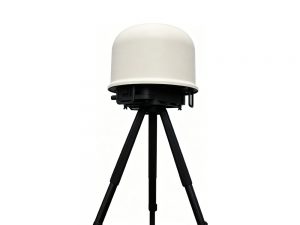
The BNTSLD400 listens across 14.00–14.50 GHz with an antenna gain north of 30 dB and an azimuth beamwidth under 3°. Its electronically scanned beam sweeps ±60° passively, grabbing 500 MHz of instantaneous bandwidth without a single emitted watt. Detection probability sits at 90% or better even when the signal is buried 10 dB below the noise floor. Once it locks on, the system spits out a bearing accurate to 1° at ranges exceeding 30 km—enough to put eyes on a terminal hiding in a vehicle or a rooftop equipment shed.
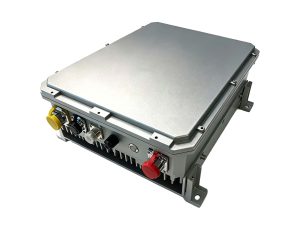
The BNTSLJ600 handles the business end. It blankets 10.95–12.75 GHz with an ERP of 60 dBW across 500 MHz. Eight simultaneous jamming frequencies can be active at once, and the waveform toolbox includes narrowband, wideband, and comb spectrum modes—up to 100 independently configured spectral lines. Modulation types cover noise FM, pseudo-random code (2FSK, MSK, BPSK, QPSK), and OFDM, all expandable. Frequency targeting error stays under 1 kHz, so every watt lands exactly where it should.
How the Loop Was Closed
The two units were tied together through the existing command console. A detection alert from the BNTSLD400 automatically cues the BNTSLJ600’s exciter with the threat bearing. The operator verifies the hit on a waterfall display and, with a single click, fires a jam pattern matched to the signal type. The entire sequence—passive detection to active denial—takes less than five seconds. If the threat disappears, the jammer drops back into standby, and the site returns to emission silence. No lingering carrier, no giveaway harmonics.
Real-World Performance and Data
During a 10-day operational test, the system was left running in full passive mode. On day three, the BNTSLD400 flagged a weak but persistent 14.25 GHz uplink at 24 km, azimuth 047.2°. The bearing pointed directly at a known overlook position used in prior surveillance incidents. The operator brought the BNTSLJ600 online with a 50 W noise-modulated waveform, targeted to the downlink channel the terminal was negotiating. The Starlink connection dropped within two seconds and remained down for the full 35-minute jamming window. Spectrum logs confirmed the terminal tried to reacquire seven times across three different frequencies; the jammer’s comb spectrum mode suppressed every attempt.
On day seven, a multi-terminal stress test was run using cooperative emitters placed at 5 km, 12 km, and 18 km. The jammer activated a comb spectrum pattern with 20 lines spread across 400 MHz. All three terminals lost link simultaneously. The 60 dBW ERP saturated the receivers so thoroughly that none of the terminals managed even a partial handshake until the jam was lifted. Ambient temperature hit 31°C inside the equipment shelter; the jammer’s forced-air cooling held internal temperature stable with no performance throttling.
The passive detection chain never triggered a false alarm that required operator intervention. The only alerts generated were verified Starlink uplinks or the controlled test signals, giving the security team confidence that the system wouldn’t cry wolf.
Project Value and Future Scalability
Before this integration, the site’s counter-Starlink posture was entirely reactive—respond to a report, send a patrol, hope to find something. Now it has a persistent, silent stare over the entire 14 GHz uplink band and an on-call surgical jammer that can silence downlinks on demand. The combination turns the EMSEC equation on its head: the defender stays dark until the moment of denial, and then only radiates in the specific band needed.
Scalability is straightforward. The comb spectrum generator supports up to 100 lines, plenty of headroom for new Starlink hop patterns as the constellation evolves. The waveform library is software-defined, so future modulation types can be pushed via firmware update. If the facility expands its perimeter, a second BNTSLD400 sensor can be networked for TDOA geolocation, turning the bearing-only cues into coordinates accurate to tens of meters. The same console can ingest feeds from counter-UAS radars, creating a single-pane-of-glass electromagnetic defense picture that covers both the sky and the spectrum. For any site serious about owning its electromagnetic territory, this is no longer an experiment—it’s the operational floor.