What is the effective range of a Starlink jammer? The short answer is that most practical systems achieve 1–10 km against a user terminal, while high-power, directional jammer modules can reach 20–50 km under ideal line-of-sight conditions. The exact number depends on power, antenna gain, frequency, terrain, and the satellite’s elevation angle.
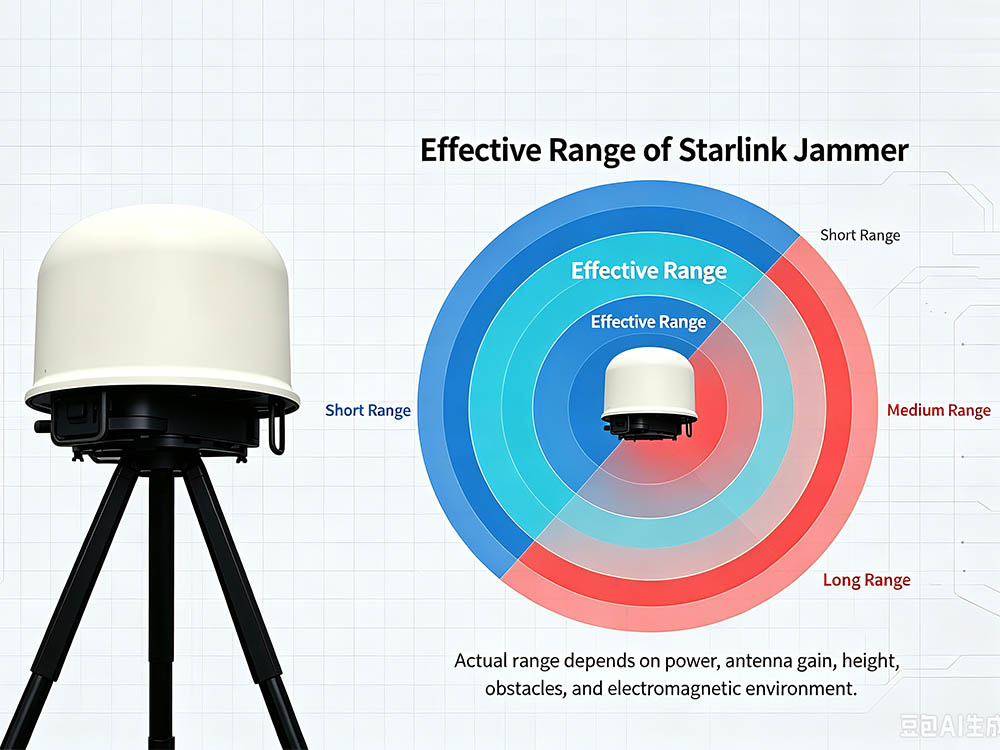
Quick Answer: What Is the Effective Range of a Starlink Jammer?
There is no single range. A Starlink jammer must either overwhelm the user terminal’s receive path or inject noise into the satellite’s uplink receiver. Most consumer-grade devices target the 14–14.5 GHz uplink because that is where the terminal transmits. Range is therefore a link-budget problem, not a fixed specification.
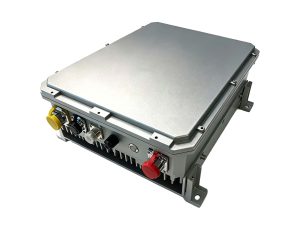
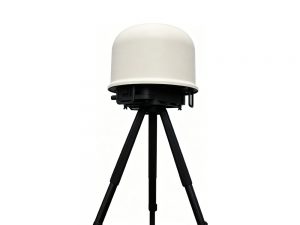
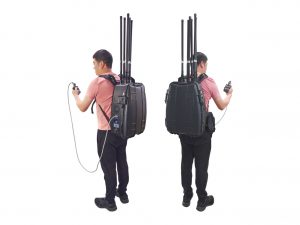
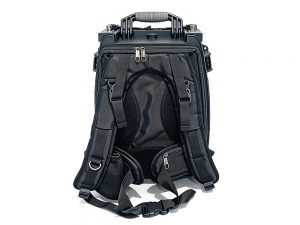
For a low-power handheld unit, expect 0.5–2 km. A vehicle-mounted system with a directional antenna can cover 5–15 km. Fixed, high-power installations with clear line of sight may reach 20–50 km. Airborne platforms can extend that further.
Uplink vs Downlink Range
Uplink jamming at 14–14.5 GHz usually offers a longer effective range than downlink jamming at 10.7–12.7 GHz. The satellite receiver is more sensitive, and the terminal’s transmit beam is easier to target. Downlink jamming requires flooding a wider user receive area, which reduces range for the same power.
5 Factors That Change the Effective Range
-
Transmit power and EIRP. More power means more range, but regulations and heat limit practical output.
-
Antenna gain and beamwidth. A narrow beam concentrates energy and extends range, but requires accurate pointing.
-
Frequency and propagation. Ku-band signals suffer rain fade and atmospheric loss, especially at 14 GHz.
-
Terrain and obstacles. Hills, buildings, and trees block line of sight and shorten effective range.
-
Target altitude and elevation angle. A satellite low on the horizon is easier to interfere with than one directly overhead.
Real-World Range Estimates
| Platform | Typical Range | Key Limitation |
|---|---|---|
| Handheld jammer | 0.5–2 km | Low power, wide beam |
| Vehicle-mounted | 5–15 km | Antenna gain, power supply |
| Fixed high-power | 20–50 km | Line of sight, cooling |
| Airborne platform | 50–100+ km | Altitude, legal restrictions |
These numbers are estimates. Actual performance varies with the jammer module, weather, and local RF noise.
Why Jammer Module Design Matters
A well-designed jammer module balances power, filtering, and thermal management. For 14–14.5 GHz operation, a band-pass filter reduces out-of-band emissions, while a high-gain amplifier boosts effective range. According to the ITU, unauthorized interference is prohibited. The FCC also enforces strict rules against jamming.
Legal and Practical Limits
Jamming is illegal in most countries. It can disrupt emergency services and trigger geolocation. Starlink and SpaceX can detect uplink interference through satellite telemetry. Penalties include fines and criminal charges.
How to Estimate Your Own Range
Use a simple link-budget approach. Start with transmitter EIRP, subtract path loss, and compare the result to the target’s receiver sensitivity.
Common Misconceptions
Many people assume that a jammer’s range is fixed. In reality, it changes with antenna height, cable loss, and even humidity. Another misconception is that higher frequency always means shorter range. At 14–14.5 GHz, a directional antenna can overcome much of the atmospheric loss. The real limit is often legal, not technical.
Final Thoughts
What is the effective range of a Starlink jammer? It ranges from under 1 km for handheld devices to over 50 km for airborne or fixed high-power systems. The deciding factors are power, antenna gain, frequency, terrain, and line of sight. Always follow local laws and use spectrum monitoring to verify performance.