When SpaceX launched its first Starlink satellites, many engineers and curious users asked what frequency does Starlink use for communication. The short answer is not a single band but a coordinated mix of Ku, Ka, E, and V bands. Each segment serves a different part of the network, from user dishes to gateway ground stations.
What Frequency Does Starlink Use for Communication in the Ku Band?
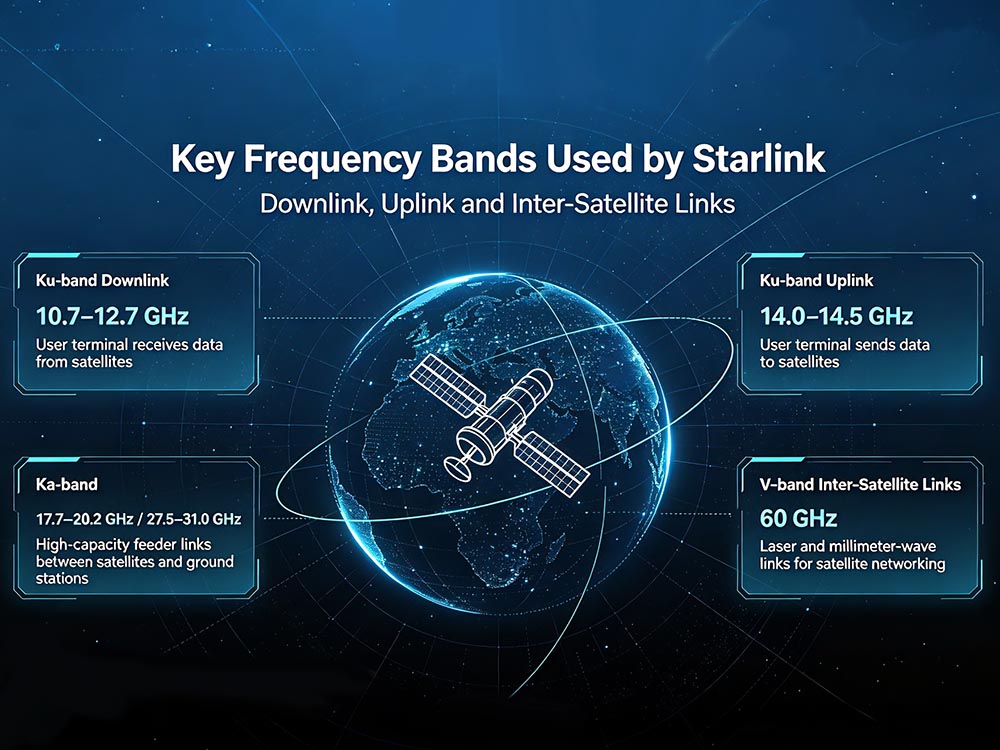
The Ku band is the workhorse for end-user connectivity. Starlink’s standard rectangular dish receives downlink signals between 10.7 and 12.7 GHz and transmits uplink signals between 14.0 and 14.5 GHz. This band balances rain fade resistance with enough bandwidth for typical home and RV users. Most early Starlink satellites relied almost entirely on Ku for user links.
Ka Band and Gateway Uplinks
Gateways, the large ground stations that connect satellites to terrestrial fiber, operate mainly in the Ka band. Downlink from satellite to gateway uses 17.8–18.6 GHz, while uplink from gateway to satellite uses 27.5–30.0 GHz. The higher frequencies allow wider channels and greater throughput, but they are more sensitive to heavy rain. The FCC has issued specific grants for these Ka-band operations — you can review the FCC authorization document for exact channel edges.
E-Band and V-Band Expansion
Second-generation Starlink satellites are adding E-band links at 71–76 GHz downlink and 81–86 GHz uplink. V-band allocations at 37.5–42.5 GHz and 47.2–50.2 GHz are also planned for future capacity. These extremely high frequencies offer massive bandwidth but require tight beam steering and suffer more from atmospheric absorption. SpaceX has already tested V-band in limited deployments, and internal documentation suggests wider rollout with the full Gen2 constellation.
Frequency Allocation Table
| Band | Downlink (Satellite to User/Gateway) | Uplink (User/Gateway to Satellite) | Primary Use |
|---|---|---|---|
| Ku | 10.7–12.7 GHz | 14.0–14.5 GHz | User terminals |
| Ka | 17.8–18.6 GHz | 27.5–30.0 GHz | Gateways, high throughput |
| V | 37.5–42.5 GHz | 47.2–50.2 GHz | Planned / experimental |
| E | 71–76 GHz | 81–86 GHz | Future Gen2 capacity |
Why Multiple Bands Matter
Using multiple frequencies allows Starlink to avoid congestion, reduce interference, and adapt to weather conditions. If heavy rain attenuates Ka or E band, the network can shift traffic to Ku or steer beams toward less affected gateways.
FAQ: What Frequency Does Starlink Use for Communication With User Dishes Only?
If you are asking what frequency does Starlink use for communication specifically between a standard residential dish and the satellite, the answer is Ku band. Your dish receives at 10.7–12.7 GHz and transmits at 14.0–14.5 GHz. The dish does not use Ka or E band for normal home service. Gateway traffic, however, uses Ka, and future mobile or aviation terminals may expand into other bands.
So, what frequency does Starlink use for communication? It is a layered, evolving system. Ku band handles most user links today, Ka band connects gateways to the internet backbone, and E/V bands promise much higher capacity for the next generation. Knowing these allocations helps users understand antenna compatibility, interference risks, and why performance changes with weather or satellite handoffs.