If you are asking, “What frequency does Starlink use for jamming?” the short answer is that no dedicated jamming channel exists. Jamming attempts must target the same radio spectrum Starlink uses for normal operations. The most exposed bands are Ku-band and Ka-band.
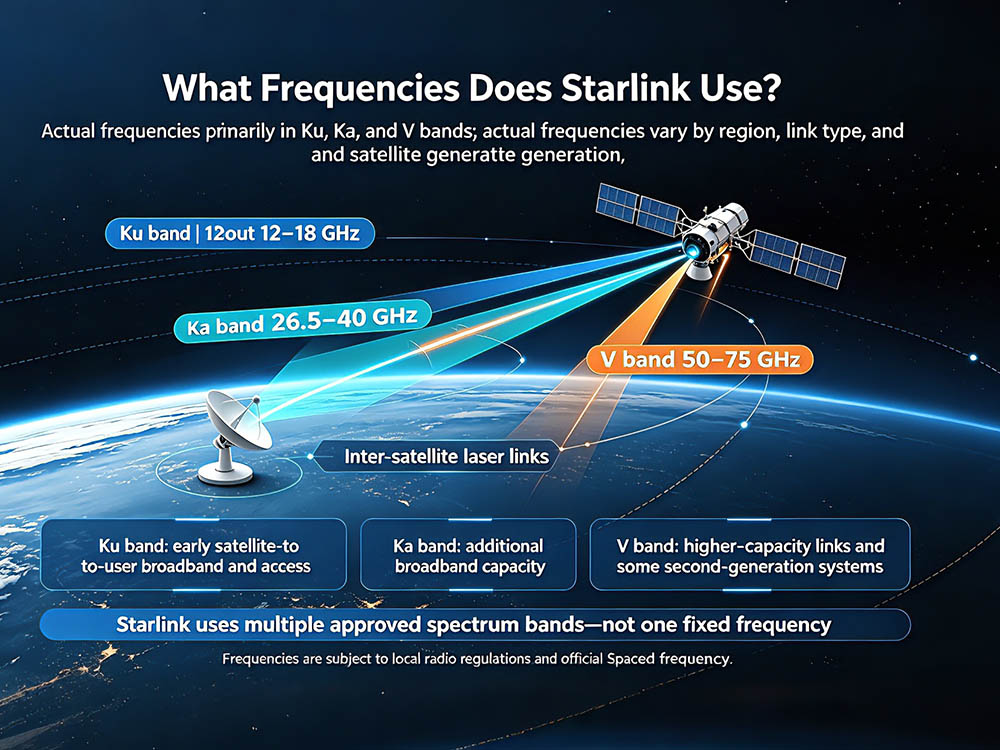
What Frequency Does Starlink Use for Jamming? Quick Answer
Starlink operates a low Earth orbit constellation with thousands of satellites. This architecture reduces latency but also creates many potential interference paths. Understanding the spectrum is the first step for spectrum managers, regulators, and satellite operators.
When engineers ask, “What frequency does Starlink use for jamming?” they usually want the spectrum a jammer must overpower. Starlink user terminals receive Ku-band downlinks at 10.7–12.7 GHz and transmit uplinks at 14.0–14.5 GHz. Ka-band links use 17.8–19.3 GHz for downlink and 27.5–30.0 GHz for uplink. E-band gateways operate around 71–86 GHz.
There is no single “jamming frequency.” A jamming signal must align with the target’s receive band, power level, and beam direction. That is why the question, “What frequency does Starlink use for jamming?” is best answered with a spectrum map rather than one number.
Starlink Bands and Jamming Exposure
The table below shows the main Starlink bands and their general exposure to jamming.
| Band | Direction | Frequency Range | Jamming Exposure |
|---|---|---|---|
| Ku-band | Downlink | 10.7–12.7 GHz | High; broad beams are easier to overpower |
| Ku-band | Uplink | 14.0–14.5 GHz | Medium; terminal transmit power is limited |
| Ka-band | Downlink | 17.8–19.3 GHz | High; used for high-throughput links |
| Ka-band | Uplink | 27.5–30.0 GHz | Medium; phased-array beams reduce risk |
| E-band | Gateway | 71–86 GHz | Low; very directional and weather-sensitive |
Ku-band downlinks are most often discussed because they cover wide areas. Ka-band links are harder to jam continuously because Starlink uses rapid beam hopping and phased-array steering. Jamming exposure depends on beamwidth, power density, and receiver sensitivity. Broad beams are easier to affect, while narrow phased-array beams require more precise jamming geometry.
Why the Question What Frequency Does Starlink Use for Jamming Matters
Regulators and network planners ask, “What frequency does Starlink use for jamming?” to evaluate resilience. Starlink uses adaptive modulation, beam hopping, and spread-spectrum methods to reduce interference. Still, any radio system can be degraded by a strong enough signal in the same band.
Authoritative sources such as the FCC satellite licensing portal and the ITU spectrum database show Starlink’s authorized frequencies. These records confirm that Starlink operates across Ku, Ka, and E-band, not a hidden jamming channel. For related background, see our Starlink interference basics guide.
Legal and Technical Realities
Jamming satellite signals is illegal in the United States, the European Union, and most other jurisdictions. In the U.S., the Communications Act prohibits intentional interference with licensed radio services. Penalties can include fines and imprisonment. Similar rules exist under EU and ITU frameworks.
This issue is often raised for defense testing, spectrum monitoring, or protective countermeasures. Authorized tests occur only in shielded labs or under strict government oversight. A jamming transmitter targeting Starlink would need high effective isotropic radiated power, accurate frequency alignment, and line-of-sight to the terminal. It would also create collateral interference across adjacent services, which is why regulators track such activity aggressively.
Key Takeaways
The answer to “What frequency does Starlink use for jamming?” is not a single number. Starlink uses multiple bands, and any jamming signal must match those bands. The main ranges are 10.7–12.7 GHz, 14.0–14.5 GHz, 17.8–19.3 GHz, and 27.5–30.0 GHz.
If you are analyzing interference, start with the downlink bands because user terminals are more exposed than gateway links. For spectrum managers, monitoring these bands is more practical than searching for a dedicated jamming frequency. Use official licensing data and calibrated spectrum analyzers to understand local exposure.