Fundamentals of Starlink Uplink Architecture
Before answering how does Starlink uplink jamming work technically, you need to understand the uplink path. Starlink user terminals transmit in the Ku-band, typically between 14.0 and 14.5 GHz. The phased-array antenna steers a narrow beam toward a low Earth orbit satellite passing overhead.
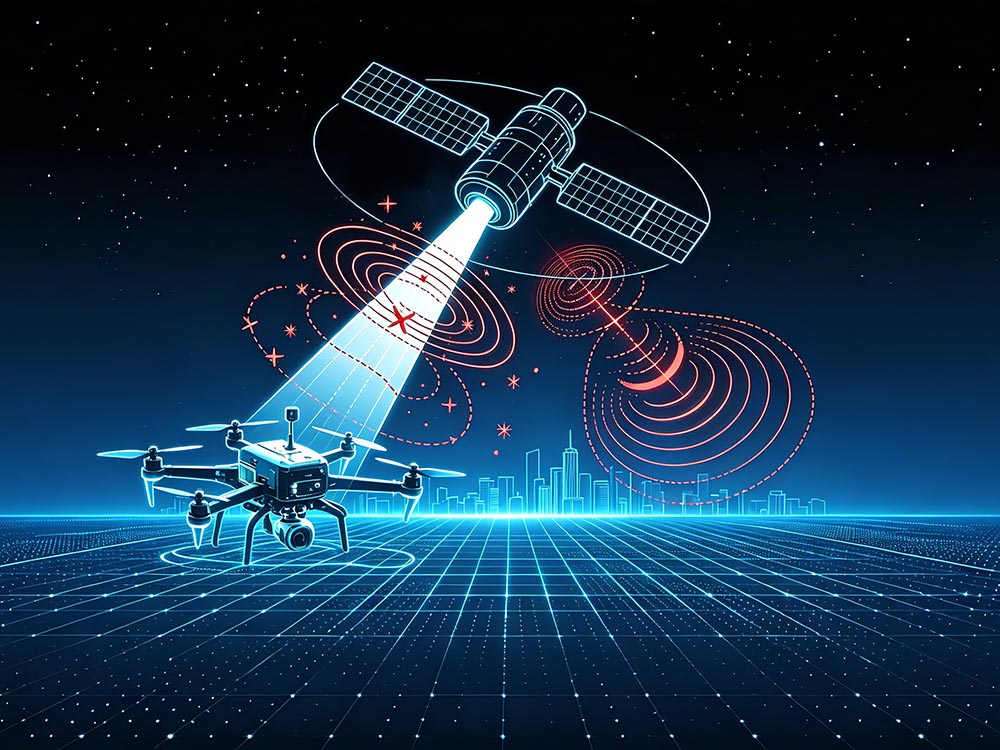
Because satellites move fast, the terminal performs frequent handovers. This creates a dynamic uplink signature. An adversary must overcome beam directivity, frequency agility, and timing constraints.
Why Uplink Jamming Is Harder Than Downlink
Most jamming discussions focus on downlink interference because the satellite signal is weak at the receiver. Uplink jamming is different. The user terminal already emits a focused beam. A jammer located far from the terminal must inject enough power into the satellite receiver, not just the terminal.
That means geography matters. The jammer needs line-of-sight to the same satellite. If the terminal is 500 km away from the jammer, the jamming signal arrives at the satellite with heavy path loss.
Core Methods: How Does Starlink Uplink Jamming Work Technically
So, how does Starlink uplink jamming work technically? Three main approaches dominate:
-
Broadband noise jamming – The jammer floods the entire uplink band with high-power noise. It does not need to know the exact frequency. The goal is to raise the noise floor above the satellite’s receiver sensitivity.
-
Narrowband tone jamming – The jammer targets a specific subcarrier or pilot frequency. This requires prior spectrum analysis but consumes less power.
-
Spoofing or protocol-aware jamming – The adversary mimics a legitimate terminal. It sends malformed timing packets or corrupts synchronization bursts. This is the most sophisticated method.
Each method exploits a different layer of the Starlink uplink stack. Broadband attacks work on the physical layer. Protocol-aware jamming attacks the scheduling and synchronization layer.
Jamming Types and Effectiveness Comparison
| Jamming Type | Required Power | Technical Complexity | Main Target Layer | Typical Range |
|---|---|---|---|---|
| Broadband noise | Very high | Low | Physical (RF) | Short to medium |
| Narrowband tone | Medium | Medium | Subcarrier allocation | Medium |
| Spoofing | Low | Very high | MAC/synchronization | Long, but risky |
Broadband noise is the most common because it requires no protocol knowledge. However, Starlink’s narrow receive beam makes it inefficient. The satellite antenna forms a receive beam toward the terminal. Signals arriving from other directions are attenuated by 20–30 dB or more. This is the first major anti-jam advantage.
Starlink’s Built-in Anti-Jam Layers
When examining how does Starlink uplink jamming work technically, you must account for Starlink’s countermeasures:
-
Receive beamforming – The satellite focuses on the terminal’s geographic location. Off-axis jammers get suppressed.
-
Frequency hopping – Uplink carriers shift according to a pseudo-random pattern. A narrowband jammer cannot track the hop sequence.
-
Power control – Terminals adjust transmit power dynamically. This makes it harder for a distant jammer to estimate the uplink signal strength.
-
Error correction and interleaving – Even if bits are corrupted, forward error correction recovers the data.
According to ITU-R recommendations on satellite interference, satellite operators should implement adaptive coding and modulation to maintain link availability under interference. Starlink applies similar principles.
Additionally, IEEE research on phased-array anti-jamming shows that adaptive null steering can place a spatial null toward a jammer while preserving the desired uplink signal. This is an active area of study for LEO constellations.
Operational Takeaways
Understanding how does Starlink uplink jamming work technically reveals a key truth: brute-force jamming is expensive and often ineffective. The phased-array architecture, coupled with dynamic frequency management, creates multiple layers of resilience.
For network planners and security analysts, the practical implication is clear. Protect the terminal’s physical location. Uplink jamming is most effective when the jammer is close to the terminal and has clear sky visibility toward the same satellite. Remote jamming requires enormous power and sophisticated timing.