Background and Pain Points
Along a remote, heavily wooded border sector, smuggling networks had switched to Starlink terminals as their primary coordination tool. Compact, battery-powered dishes hidden in caves or under camouflage nets provided a high-speed link far beyond the reach of any cellular tower. Patrols carrying handheld spectrum analyzers occasionally caught a brief flicker on 14 GHz, but by the time they could react, the transmission was long over. The border unit needed a way to passively watch the entire valley for those faint uplinks, fix a location from a distance, and then put a jammer directly onto the downlink—without driving a large vehicle into every ravine and giving away their position. The answer was a layered architecture: a fixed detection post paired with backpack jammers carried on foot.
What Was Procured
The unit integrated two complementary systems into a single kill chain.
-
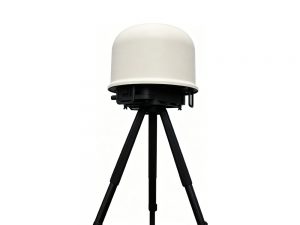
1 × Starlink Detection System BNTSLD400: mounted on a hilltop observation tower, this unit covers 14.00–14.50 GHz with an antenna gain ≥30 dB and an azimuth beamwidth ≤3°. It scans ±60° electronically, providing 500 MHz of instantaneous bandwidth with a detection probability ≥90% even at S/N = -10 dB. Direction finding accuracy reaches 1°, and the uplink DF range extends beyond 30 km.
-
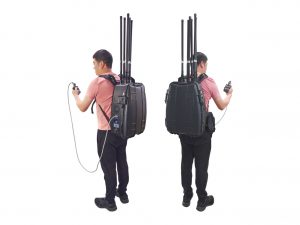
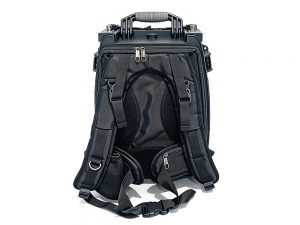
2 × Backpack Starlink Jammer BNT-S900-B8: each weighing roughly 16 kg without antennas, these packs house eight independent 50 W SDR-driven channels covering the Ku-band downlink (10.7–12.75 GHz). The internal 29.4 V / 30 Ah Li-ion battery delivers 60–90 minutes of continuous jamming. Operators can use omnidirectional whips to create a 1–1,500 m isolation bubble, or switch to directional high-gain horns for stand-off denial beyond 5 km.
How the Sensors and Jammers Worked Together
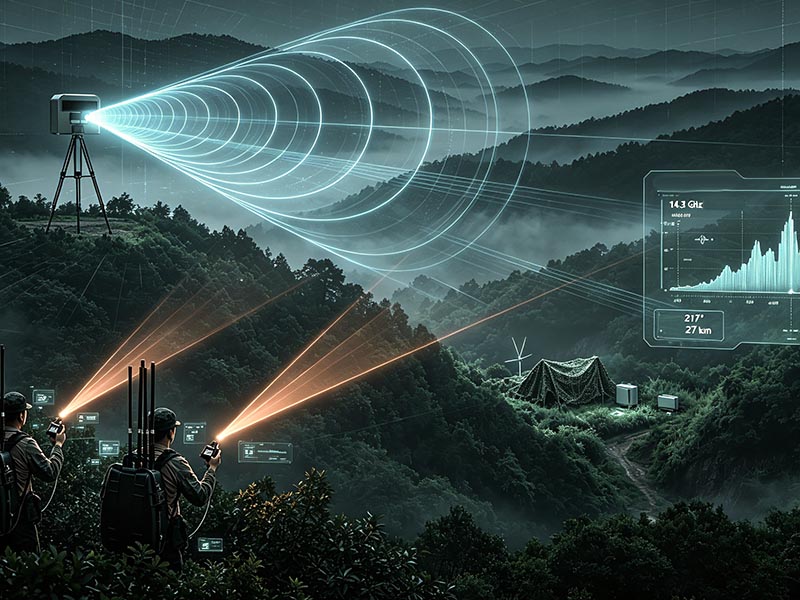
The BNTSLD400 fed bearing and range data to a ruggedized tablet over an encrypted long-range mesh network. The moment an uplink appeared, the command post sent a bearing line and estimated distance to the two backpack teams. Each BNT-S900-B8 operator used the external wired controller to dial in the specific Ku-band channel and waveform—usually a comb spectrum pattern matching the terminal’s frequency hopping behavior. As soon as a jamming team confirmed they were in range, they activated denial. Back at the command post, the operator watched the Starlink signal vanish from the BNTSLD400 waterfall display in real time, giving immediate confirmation that the loop was closed.
Real-World Performance and Data
Over a month-long counter-smuggling surge, the layered system logged six confirmed terminal suppressions.
In the most operationally significant incident, the BNTSLD400 detected a persistent 14.3 GHz uplink at 27 km. The bearing pointed directly at a forested ravine with a known history of night crossings. Two backpack teams were dispatched, hiking 3 km through dense vegetation to set up 800 meters from the estimated target area. Both operators selected comb spectrum mode—12 independent lines spread across 300 MHz—and fired simultaneously. The Starlink terminal dropped offline in under three seconds. Spectrum logs later showed the terminal attempted 12 frequency hops over the next 40 minutes and never regained a satellite lock. With the communications link severed, a separate intercept patrol moved in and seized the terminal, two battery packs, and a significant quantity of contraband.
Equally important, the detection chain generated zero false alarms during the entire month. Every alert correlated to a genuine Starlink transmission or a planned exercise injection, giving operators the confidence to scramble backpack teams without hesitation.
Value and Future Scalability
Pairing a fixed detection system with man-portable jammers closed the find-and-deny loop without ever exposing a large vehicle to adversary observation. The architecture scales easily: adding a second BNTSLD400 sensor enables TDOA geolocation, yielding target coordinates accurate to tens of meters and reducing the search area for backpack teams. The BNT-S900-B8 waveform library is software-defined, so new modulations can be loaded as adversary terminals evolve. The same command app that displays DF bearings can ingest feeds from counter-UAS radars, building a single-pane electromagnetic picture that covers low-orbit satellite links, drones, and ground-based threats simultaneously. For border forces confronting cheap satellite communications, this detect-then-jam model has moved from an experimental concept to a standard operating procedure.