Search queries and industry discussions often frame 14–14.5 GHz as the primary Starlink jamming frequency. The statement is directionally useful, but technically incomplete. In Starlink’s Ku-band user link, 14.0–14.5 GHz is the Earth-to-space uplink; the corresponding user downlink sits at 10.7–12.7 GHz. That distinction explains most of the attention—and most of the confusion.
This article examines why the 14–14.5 GHz band keeps appearing in Starlink interference analysis, what it does in the network, and why “primary” should be treated as shorthand rather than a universal rule. It does not provide jamming instructions; unauthorized interference is illegal in most jurisdictions and can disrupt safety-critical communications.
Where 14–14.5 GHz sits in the Starlink link
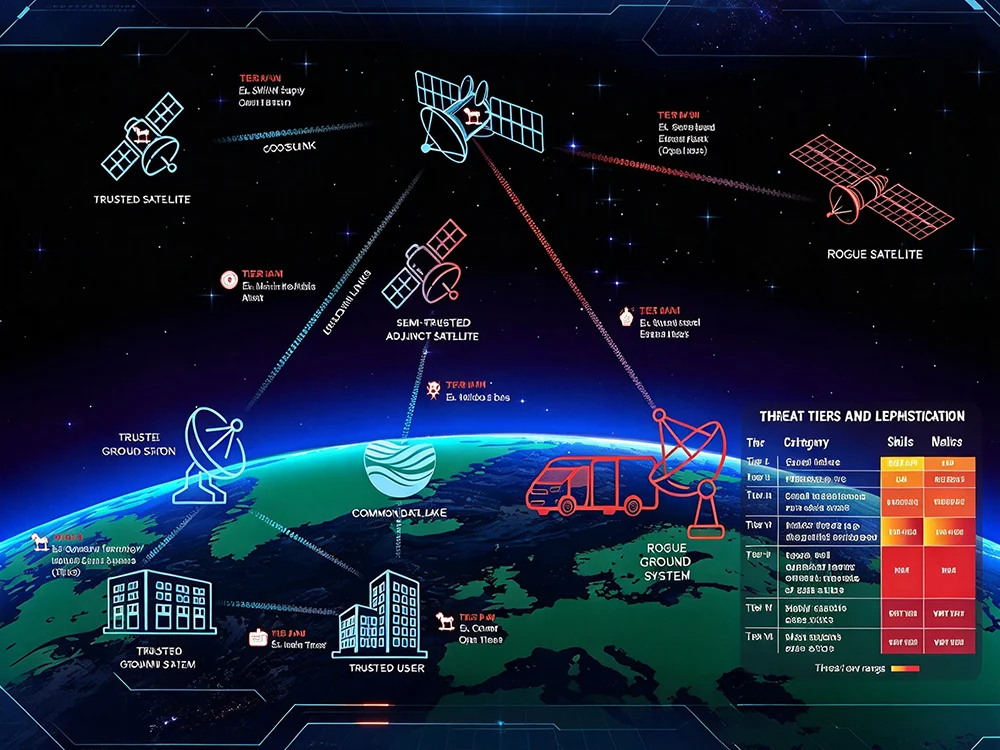
Starlink uses multiple bands and link types. The Ku-band user link is the most familiar: the terminal receives in the 10.7–12.7 GHz range and transmits in the 14.0–14.5 GHz range. Gateway or feeder links generally use higher-frequency bands and have different coordination requirements.
| Link segment | Typical band | Direction | Relevance to interference discussions |
|---|---|---|---|
| Ku-band user downlink | 10.7–12.7 GHz | Space to Earth | Interference affects the user terminal’s receive path |
| Ku-band user uplink | 14.0–14.5 GHz | Earth to space | Often cited as the “primary” jamming focus because it is the standardized user transmit band |
| Gateway/feeder link | Higher bands, varies by system | Earth to space / space to Earth | Different geometry, tracking, and coordination; less often simplified as “the Starlink jamming frequency” |
The key point is direction. A ground-based emitter targeting 14–14.5 GHz is not trying to overwhelm a nearby user terminal’s receiver. It is trying to raise the noise floor at the satellite’s uplink receiver. That is a different engineering problem from downlink interference, and it is one reason the band is discussed separately.
Why the band is often called “primary”
The label persists because several practical and regulatory factors converge on the user uplink.
| Factor | Why it points to 14–14.5 GHz | Important qualifier |
|---|---|---|
| Standardized allocation | 14.0–14.5 GHz is a defined Ku-band uplink segment for user terminals | National allocations and coordination rules still apply |
| Satellite receiver exposure | Uplink interference competes with many terminal transmissions at the satellite | A ground emitter needs the right geometry, power, and beam alignment; this is not trivial |
| Terminal density | Many user terminals can share a spot beam and frequency reuse pattern | Beam planning, polarization, and scheduling complicate real-world effects |
| Monitoring and enforcement | Regulators and spectrum managers monitor uplink bands for unauthorized emissions | Jamming is illegal; enforcement and penalties are significant |
| Public shorthand | “14–14.5 GHz” is easy to cite in summaries | It is not the only Starlink band and not always the “best” target |
In other words, 14–14.5 GHz is prominent because it is the standardized user transmit band, not because it is a magic frequency. Any interference effect depends on the target link, satellite beam, emitter location, power, bandwidth, timing, and the network’s resilience features.
What the “primary” label gets wrong
First, Starlink is not a single-frequency system. It uses multiple bands, spot beams, frequency reuse, and gateway links. Calling 14–14.5 GHz “the” Starlink jamming frequency oversimplifies the architecture.
Second, uplink and downlink interference are not interchangeable. Downlink interference at 10.7–12.7 GHz affects what the terminal can receive. Uplink interference at 14–14.5 GHz affects what the satellite can receive from terminals. The operational outcomes, equipment geometry, and countermeasures differ.
Third, “primary” does not mean “easy.” Uplink interference from the ground must reach a satellite receiver while competing with path loss, beam pointing, polarization, and the satellite’s own receiver characteristics. Simplified online claims often ignore these constraints.
For a broader comparison of frequency choices and why no single band is universally “best,” see the companion analysis: What Is the Best Frequency to Jam Starlink?.
Legal and spectrum-management reality
The ITU Radio Regulations and national spectrum laws prohibit harmful interference. Unauthorized jamming is not a legitimate testing method; it can disrupt communications, including emergency services, and expose operators to severe penalties. Legitimate work in this area belongs in licensed spectrum-monitoring, interference-detection, and authorized electronic-warfare test environments with proper coordination.
Bottom line
14–14.5 GHz is often described as the primary Starlink jamming frequency because it is the Ku-band user uplink—the standardized Earth-to-space path that feeds the satellite receiver. That makes it a logical focal point in interference discussions, but the label is a simplification. A serious analysis must separate uplink from downlink, account for beam and geometry effects, and respect the legal boundaries around spectrum use.