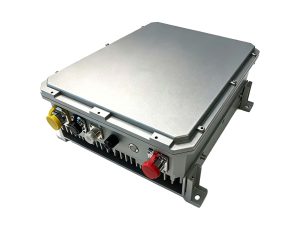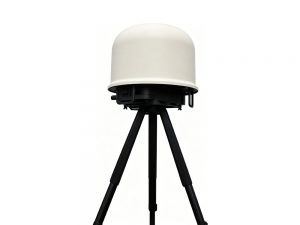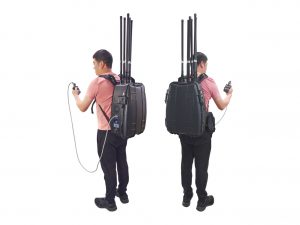
Backpack Starlink jammer inquiries usually come from field planners, integrators, and procurement teams who need answers fast—not marketing language. This Q&A format article addresses the questions buyers actually ask about the BNT-S900-B8, a portable multi-band system built around an eight-channel, 50 W-per-channel architecture. Each section answers one question directly, with tables where numbers speak louder than paragraphs.
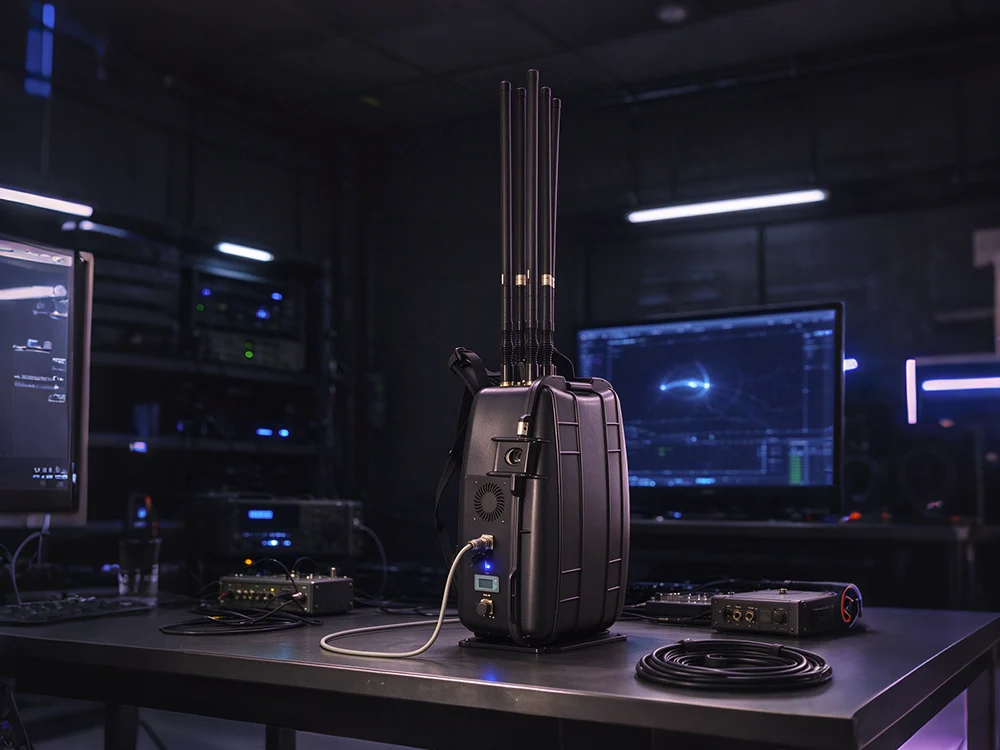
Q1: What Exactly Is the BNT-S900-B8 Backpack Starlink Jammer?
Short answer: It is a man-portable, multi-band RF denial system housed in a custom ergonomic backpack. It is designed to disrupt satellite terminals—including Starlink user terminals—across eight frequency bands.
The unit weighs approximately 16 kg without antennas and measures 488 × 369 × 189 mm. That form factor lets a single operator carry full multi-band capability into locations where vehicle-mounted racks cannot go: border zones, temporary checkpoints, rooftop positions, or forward operating bases.
Unlike a stripped-down handheld, the BNT-S900-B8 integrates a software-defined radio (SDR) exciter, eight independent 50 W channels, active cooling, and a 29.4 V / 30 Ah lithium-ion battery in one enclosure. The backpack shell is purpose-built rather than adapted, with quick-release buckles and padded straps that work over body armor.
Who typically asks about it: Rapid-response teams, critical infrastructure security planners, spectrum regulatory units, and integrators building layered counter-satcom or counter-UAS configurations.
Q2: How Does a Backpack Starlink Jammer Actually Work?
Short answer: It generates shaped interference waveforms on the same frequencies used by target terminals, raising the noise floor at the receiver until the satellite link can no longer be decoded.
The SDR core receives target bearing data from companion detection-and-location sensors. It then directs disruption energy at the threat terminal. Against Starlink downlinks that typically arrive at −60 to −80 dBm, the system injects enough noise to exceed the wanted signal level at the receiver.
Two antenna modes are available:
| Mode | Antenna type | Typical effect | Best for |
|---|---|---|---|
| Directional | High-gain horn antennas | Extended stand-off range (up to ~5 km line-of-sight) | Precision targeting of a known terminal |
| Omnidirectional | Full-band whip antennas | Localized saturation within 1–1,500 m | Area denial and rapid setup |
Both modes can run simultaneously. That gives a field commander the option to maintain a local denial bubble while also reaching out toward a specific threat emitter.
A note on physics: Performance assumes line-of-sight conditions. Dense urban clutter, terrain, and building materials reduce effective range. For background on terminal vulnerability, the Kratos defense brief on tactical jamming is a useful external reference.
Q3: What Are the Core Specifications?
Short answer: Eight bands, 50 W per channel, 800 W system draw, forced-air cooling, and a compact 16 kg frame.
Frequency coverage
| Band | Uplink / Downlink range | RF output |
|---|---|---|
| S-Band (Low) | 1980 – 2010 MHz | 50 W |
| S-Band (High) | 2170 – 2200 MHz | 50 W |
| C-Band (Low) | 3700 – 4200 MHz | 50 W |
| C-Band (High) | 5925 – 6425 MHz | 50 W |
| Ku-Band (Low) | 10700 – 11450 MHz | 50 W |
| Ku-Band (Mid) | 11450 – 12100 MHz | 50 W |
| Ku-Band (High) | 12100 – 12750 MHz | 50 W |
| GNSS L1/L2 | 1170 – 1280 MHz | 50 W |
| GNSS L5 | 1550 – 1620 MHz | 50 W |
General parameters
| Parameter | Value |
|---|---|
| System power draw | 800 W |
| Battery | 29.4 V / 30 Ah Li-ion |
| Run-time | 60–90 minutes continuous |
| Isolation radius | 1–1,500 m (omnidirectional mode) |
| Dimensions | 488 (L) × 369 (W) × 189 (H) mm |
| Weight | ≈16 kg (excluding antennas) |
| Cooling | Forced air with heat-sink array |
| Control | External wired controller |
The external controller lets the operator select bands, adjust output, and kill transmission instantly—without opening the pack. That matters in field conditions where seconds count.
Q4: How Long Can It Run, and How Far Does It Reach?
Short answer: 60–90 minutes on the standard battery, with optional hot-swap batteries extending field time. Reach depends on antenna mode: roughly 1–1,500 m omnidirectional, up to about 5 km directional under line-of-sight.
Runtime factors
| Factor | Effect on runtime |
|---|---|
| Number of active bands | More bands draw more power |
| Output power setting | Lower power extends battery life |
| Ambient temperature | High heat increases cooling load |
| Battery age and cycles | Capacity degrades over time |
| Hot-swap accessory | Enables near-continuous operation |
Range factors
| Factor | Effect on range |
|---|---|
| Antenna type | Directional horns reach farther than whips |
| Line of sight | Obstructions sharply reduce range |
| Target signal strength | Weaker downlinks are easier to overwhelm |
| Terrain and clutter | Urban and mountainous areas cut effective distance |
| Transmit power setting | Higher output extends reach but drains battery |
Planners should treat published range figures as best-case, line-of-sight estimates. Field testing in the actual operating environment is the only reliable way to set expectations.
Q5: Which Operational Scenarios Fit This Platform?
Short answer: Three primary mission sets are named for this system, plus adjacent roles where portable RF denial is useful.
| Scenario | What the system does | Why portability matters |
|---|---|---|
| Maneuver warfare | Denies adversary C2 links over LEO constellations during assault or withdrawal | Squads move without vehicle support |
| Critical infrastructure protection | Blocks unauthorized surveillance feeds and remote-triggered threats around plants, borders, and government sites | Rapid redeployment as threat picture changes |
| Spectrum policing | Direction-finding interface identifies rogue terminals; timed bursts restore spectrum order | Regulators need mobile, precise intervention |
| Counter-UAS integration | Pairs with portable drone jammers to create a moving counter-satcom and C-UAS bubble | Layered defense in one backpack footprint |
Q6: What Ships in the Box, and What Is Optional?
Short answer: The main unit comes pre-installed in the backpack, with controller, antennas, and charging hardware. Directional antennas, spare batteries, and solar charging are optional.
Standard package
| Item | Included |
|---|---|
| BNT-S900-B8 main unit (pre-installed in backpack) | Yes |
| AC charging adapter | Yes |
| External wired controller | Yes |
| Controller interface cable | Yes |
| Eight full-band omnidirectional antennas | Yes |
| Ruggedized power cord | Yes |
Optional accessories
| Accessory | Purpose |
|---|---|
| Directional antenna kit | Extends stand-off range |
| Spare battery | Hot-swap field extension |
| Solar charging panel | Off-grid resupply |
| Frequency customization | Mission-specific band tailoring |
Technical sales teams can provide a live demo video and discuss frequency customization. For pricing context across the category, see our analysis of Starlink jammer price range and cost factors. For supply-chain questions, read Starlink jammer OEM and ODM services.
Compliance and Legal Considerations
This section is not optional reading. Radio jamming is prohibited in most jurisdictions, including the United States, EU member states, the UK, and Australia. The FCC explicitly bans the operation, marketing, and sale of jamming devices. The ITU Radio Regulations require protection of authorized radio services.
Before any deployment, buyers must confirm:
-
Whether the destination country permits possession or use of RF denial equipment
-
Whether an export license is required
-
Whether the end user is a government or authorized agency with a lawful mandate
-
Whether local spectrum authorities have granted explicit authorization
Official regulatory context is available from the FCC jammer enforcement page and the ITU spectrum management resources.
FAQ
How much does a backpack Starlink jammer weigh?
The BNT-S900-B8 weighs approximately 16 kg excluding antennas. With antennas and accessories, field weight is higher, so load planning matters.
Can the backpack Starlink jammer be carried by one person?
Yes. The custom ergonomic pack with quick-release buckles and padded straps is designed for single-operator carry, including over body armor.
Does it cover GNSS as well as satellite communications?
Yes. The eight-band configuration includes GNSS L1/L2 and L5 coverage alongside S, C, and Ku bands.
Can the battery be swapped in the field?
Yes, with the optional hot-swap-capable battery architecture. The standard battery provides 60–90 minutes of continuous output.
Is a backpack Starlink jammer legal to buy?
Legality depends entirely on the destination country, end user, and authorization. In many jurisdictions, purchase and possession are restricted or prohibited. Consult local counsel and export control authorities before any transaction.
Conclusion
The backpack Starlink jammer category answers a specific operational question: how to carry multi-band RF denial into places vehicles cannot reach. The BNT-S900-B8 addresses that with eight 50 W channels, SDR-driven waveform shaping, 60–90 minutes of battery runtime, and a 16 kg carry weight. The Q&A above covers the specifications buyers ask about first—bands, power, range, runtime, scenarios, and package contents. Compliance comes before procurement: confirm the legal pathway in your jurisdiction before any deployment discussion begins.