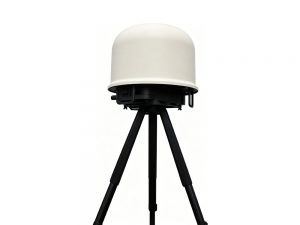
The short answer is nuanced: a Starlink jammer can disrupt service in a limited area, but it cannot reliably guarantee a complete internet blackout in most real-world scenarios. That distinction is becoming more important as low-Earth-orbit (LEO) satellite links are used by ships, remote enterprises, emergency teams, and defense organizations.

Starlink is not a single radio link. It is a moving constellation. User terminals use electronically steered phased-array antennas to track satellites, hand over between passes, and shift across beams and frequencies. A jammer that affects one channel, one beam, or one satellite path may create a temporary outage, but the network can often route around the interference.
What Jamming Can and Cannot Do
| Factor | Effect on Starlink service | Likelihood of complete blocking |
|---|---|---|
| Downlink jamming | Interferes with the user terminal’s receive path | Possible in a local area, but not network-wide |
| Uplink jamming | Targets terminal-to-satellite transmissions | Difficult; requires power, aim, and timing |
| GNSS jamming | Disrupts positioning and timing aids | Usually not a full data outage by itself |
| Frequency agility | Network shifts channels, beams, and assignments | Reduces sustained jamming success |
| Multi-satellite constellation | Many satellites pass overhead continuously | Makes total coverage very difficult |
| Backup networks | Fiber, LTE, microwave, or other satellite links | Users may remain online through other paths |
| Regulation | Jamming is illegal in many countries | Increases detection and enforcement risk |
Why “Complete” Is Hard to Achieve
A starlink jammer must overcome physics, network design, and geography. Downlink interference may be effective if it is close to a receiving terminal and covers the right frequencies. But Starlink terminals are not fixed to one satellite. They can switch beams and satellites as the constellation moves. The network also uses dynamic resource management, meaning a single interfering signal is unlikely to shut down an entire region.
Uplink jamming is even more complex. It must target the signal traveling from the terminal to the satellite. That requires enough power, accurate direction, and knowledge of the current link. Even then, the satellite may have multiple beams and users, and the network can adjust.
GNSS jamming is sometimes discussed alongside Starlink interference because satellite terminals may use GPS/GNSS for timing and location. However, disrupting GNSS does not automatically equal a full Starlink internet outage. It may affect initialization, tracking, or timing in some cases, but it is not the same as blocking the data link itself.
Regulatory and Industry Response
In the United States, the FCC generally prohibits the marketing, sale, and operation of signal jammers, including devices aimed at satellite services. Many other countries have similar restrictions. Satellite interference can also raise international coordination issues because radio spectrum is managed globally.
For operators, the practical response is resilience. Enterprise and government users are increasingly adopting multi-path connectivity: LEO satellite plus LTE, fiber, or GEO backup. Satellite operators continue to invest in interference monitoring, beam flexibility, encryption, and network management. The goal is not to make jamming impossible, but to make complete disruption expensive, temporary, and detectable.
Bottom Line
Can a Starlink jammer block internet access completely? In narrow, local, and temporary cases, it may disrupt Starlink service for some users. As a reliable method to shut down the entire Starlink network—or all internet access in a region—it is far less likely. The combination of a moving constellation, dynamic spectrum use, multiple satellites, backup networks, and legal enforcement makes complete blocking a difficult and risky objective.