The phrase “Starlink jammer output power requirements for LEO satellites” suggests a straightforward engineering number: a certain wattage needed to disrupt a low Earth orbit connection. In practice, engineers, regulators and satellite operators say that framing is misleading. Jamming performance is shaped by geometry, spectrum, antenna behavior, waveform design and legal limits—not by a single power rating.
Why LEO makes the power question harder
LEO satellites move quickly relative to ground observers. A link that is easy to disturb for a few seconds may be difficult to affect continuously. Starlink’s use of phased-array user terminals, spot beams and frequency reuse further complicates any generalized calculation. The result is that output power requirements change by scenario, not by constellation alone.
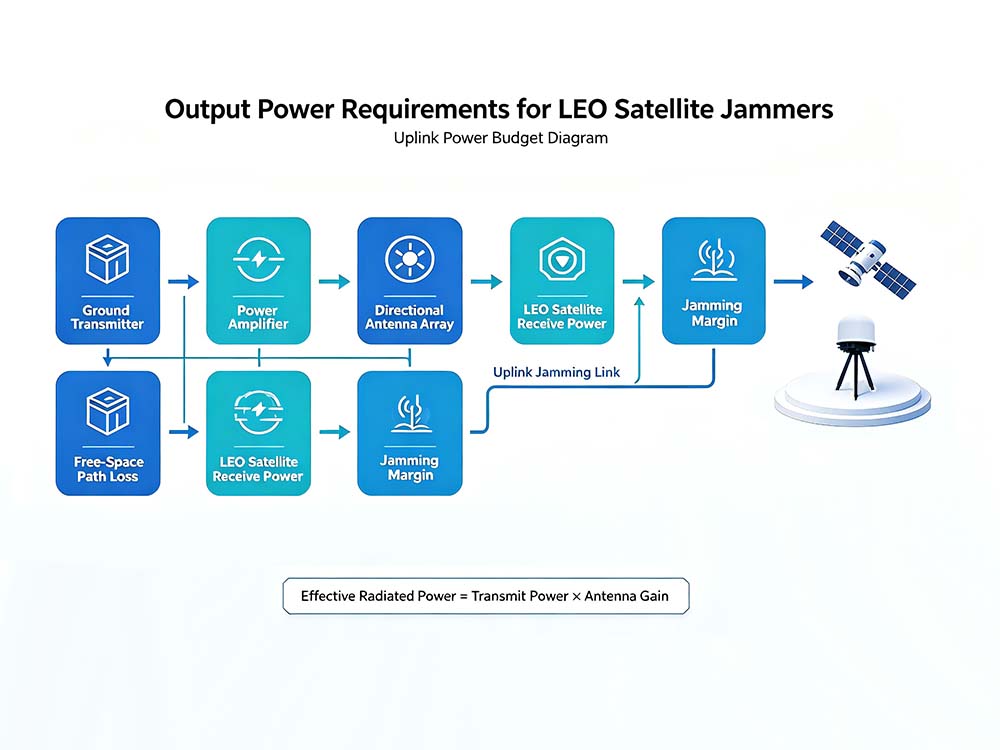
This is also why public discussion often confuses raw transmitter power with effective isotropic radiated power (EIRP). A high-gain directional antenna can produce a stronger interference effect at a target than a lower-gain system with similar wattage—but it also demands more precise pointing and tracking. For a fast-moving LEO target, pointing errors and Doppler shifts can erase theoretical advantages.
Regulation is the first constraint
Unauthorized jamming of satellite communications is illegal in many countries and is prohibited under international radio regulations. Regulators treat intentional interference as a serious offense because it can affect safety, emergency communications, aviation, maritime users and neighboring satellites. Any industry discussion of “output power requirements” therefore sits inside a legal boundary: there is no lawful market for jammer specifications targeting Starlink or other LEO systems.
That regulatory reality is shaping the news cycle. Rather than publishing power figures, equipment vendors and research groups are focusing on interference detection, geolocation and resilient waveform design. Military and government users, meanwhile, tend to keep specific electronic warfare parameters classified.
variables that shape any theoretical interference budget
| Variable | Why it matters | Public clarity |
|---|---|---|
| Link direction | Uplink and downlink jamming stress different receivers and geometries | Low |
| LEO pass geometry | Range, elevation and duration change rapidly | Low |
| Antenna gain and beamwidth | Higher gain can reduce raw power needs but increases pointing demands | Medium |
| Bandwidth and waveform | Wider, agile or spread-spectrum signals are harder to overwhelm efficiently | Low |
| Polarization and frequency agility | Mismatches and hopping reduce practical effectiveness | Medium |
| Regulatory limits | Harmful interference is prohibited; national rules may add constraints | High |
| Collateral impact | Adjacent satellites and users can be affected, raising liability | High |
The table explains why no credible public specification can reduce Starlink jammer output power to a single number. Each row can shift the required EIRP, duty cycle and processing burden by orders of magnitude in a real deployment scenario.
Industry response: resilience over raw power
Starlink and other LEO operators continue to invest in anti-jam features such as beamforming, frequency agility, encryption, interference monitoring and rapid network reconfiguration. These defenses raise the cost and complexity of any interference attempt, even if a jammer has substantial output power. In turn, defense contractors are emphasizing software-defined radios, distributed sensing and machine-learning classification rather than one-size-fits-all power ratings.
Analysts also note that the most important metric may be persistence, not peak power. A brief high-power burst may interrupt a link, but LEO constellations can hand over to another satellite or adjust beams. Sustained interference across a wide area is much harder—and far more likely to attract regulatory enforcement.
Outlook
The market conversation around “Starlink jammer output power requirements for LEO satellites” is likely to remain active because defense planners want to understand vulnerabilities. But the public answer will stay constrained by law, classification and physics. For satellite operators, the priority is clear: build links that are harder to jam, detect interference quickly and recover gracefully. For everyone else, the key takeaway is that output power alone tells only a small part of the story.
FAQ
Is there a public wattage requirement for jamming Starlink?
No. Credible figures depend on classified or scenario-specific factors, and unauthorized jamming is illegal.
Why is EIRP more relevant than watts?
EIRP combines transmit power and antenna gain, which better reflects how interference reaches a target receiver.
What are LEO operators doing about jamming?
They are investing in beamforming, frequency agility, encryption, interference detection and network resilience.